The Müller Group develops controlled nanomaterials and electrocatalytic processes for sustainable energy solutions, green chemistry transformations, and aqueous destruction of per- and polyfluoroalkyl substances (PFAS). Importantly, we answer fundamental questions what drives functionality by systematic studies of how structural, compositional, and electronic details govern performance, and we develop a quantitative understanding of mechanisms.
We rationally design tailored nanomaterials and realize them by a proven-to-be-successful laser method that Müller has advanced into a flexible synthetic tool, capitalizing on its unique advantages of rapidity, control of size and composition, unnecessity of surfactants, and ease of preparation of multimetal nanostructures. Our laser method is game changing with regard to its capability of preparing controlled nanostructures in sufficiently large quantities to study them in bulk, and doing so quickly enough that series of nanostructures are accessible.
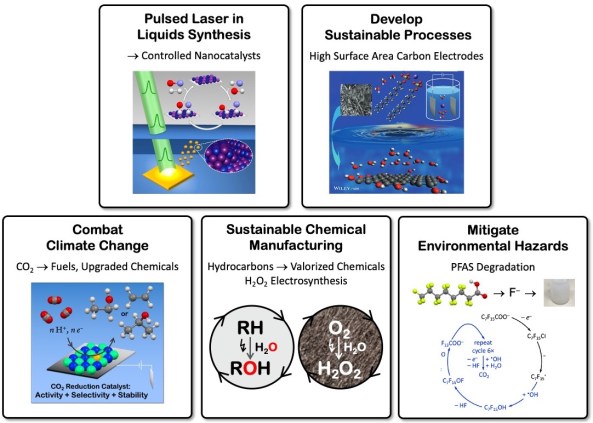
Systematic physical-property–functionality relationships of these laser-made nanomaterials, combined with benchmarking electrochemical performance assays, product analyses, or efficacy testing, allows us to establish what controls functionality and gain the quantitative atomistic-detail understanding that is key for disruptive benefits.
We leverage synergies between the Chemical Engineering, Chemistry, and Materials Science Programs at the University of Rochester and our group’s expertise in laser synthesis of controlled multimetal nanomaterials, electrocatalysis, product analyses, and mechanistic studies. Our approach uniquely enhances our fundamental understanding of nanomaterials and paves the way for unparalleled innovations.
Sharing of Data and Materials
Sharing of data and/or materials can be requested from PI Müller. A formal request via e-mail is required, along with a written promise of acknowledgment of the funding agency and the researchers who originally produced the data and/or materials if the are used in a subsequent publication. Data and/or materials samples will be available either free or at low costs after interested parties sign a Memorandum of Understanding stating: 1) they are a non-profit or research organization, 2) they will not use the materials in paid consultancy nor charge others for use of the materials, 3) they will reference the materials in any publications or presentations, and 4) they will not change the materials without express written permission of PI Müller.
 astridmuellergroup.org